

I wanted to share my latest purchase with you. I found another deep value stock!
On Friday, September 11, I bought Vivendi. At a reference share price of €1.46, my net asset value estimate of €3.12 implies a discount of approximately 53%. The most interesting part is that its largest investment, Universal Music Group, is also trading at its lowest valuation ever.
This creates two obvious possible sources of upside. Vivendi’s discount could narrow, while a recovery in UMG could lift the value of the assets behind it. A potential takeover (which is a likely scenario) could accelerate either process, but my investment does not require one.
I have followed Vivendi for several years. Earlier this year, Bill Ackman’s proposal for UMG brought renewed attention to the group. I stayed on the sidelines because I did not believe Bolloré would accept the proposal. The prospect of a deal was insufficient reason for me to buy. Turned out I was right.
By September, Vivendi shares had fallen almost 40%. The takeover excitement had faded, a court ruling had disappointed minority investors, and UMG had fallen sharply after its half-year results.
That was when I decided to invest. At this price, the gap between the market value and the assets had become large enough to compensate me for considerable uncertainty. A discount of 53% to a quality asset that is trading at its lowest valuation ever. This is the kind of situation I look for at Deep Value Stocks.
What remains of Vivendi
Vivendi is a French investment holding company focused on media and entertainment. Its origins lie in a very different business. Founded in 1853 as Compagnie Générale des Eaux, it originally supplied water to French cities. Over time, the group expanded into other industries, including telecommunications and media, and adopted the Vivendi name in 1998.
Through acquisitions, Vivendi grew into a sprawling group whose businesses included music, television, movies, video games and mobile networks. Universal Music Group and the French pay-TV operator Canal+ became some of its best-known assets. But the company has since spent years selling businesses and separating others into independently listed companies, gradually dismantling that empire.
One of the most important steps came in 2021, when Vivendi distributed a 60% stake in Universal Music Group to its shareholders and retained roughly 10%. UMG began trading separately in Amsterdam. Shareholders now owned most of their exposure to the music business directly, while a smaller stake remained inside Vivendi.
Another major breakup followed in December 2024. Canal+, Havas and Louis Hachette Group became separately listed businesses. Shareholders received direct interests in those companies, leaving a much smaller Vivendi behind. An unadjusted long-term Vivendi share-price chart therefore gives a misleading picture of shareholder returns.
Today’s Vivendi is mainly an investment holding company. UMG dominates the portfolio, alongside stakes in Banijay, Lagardère, MediaForEurope and Prisa. Vivendi also owns Gameloft, the video game developer, and smaller interests in magazine publishing.
Banijay produces and distributes television content and owns an online sports betting business. Lagardère provides exposure to book publishing and travel retail. MediaForEurope owns commercial television businesses, while Prisa operates in Spanish-language media and education.
These investments matter, although none is individually large enough to determine the outcome in the way UMG can. Together, the listed holdings outside UMG account for about €1.4 billion in my valuation.
The first discount
The table below sets out my valuation using the September 11 market snapshot. Balance-sheet figures come from the June 2026 accounts. Listed investments are valued using the market-value inputs shown, while the unlisted businesses use estimates in line with analyst valuations.
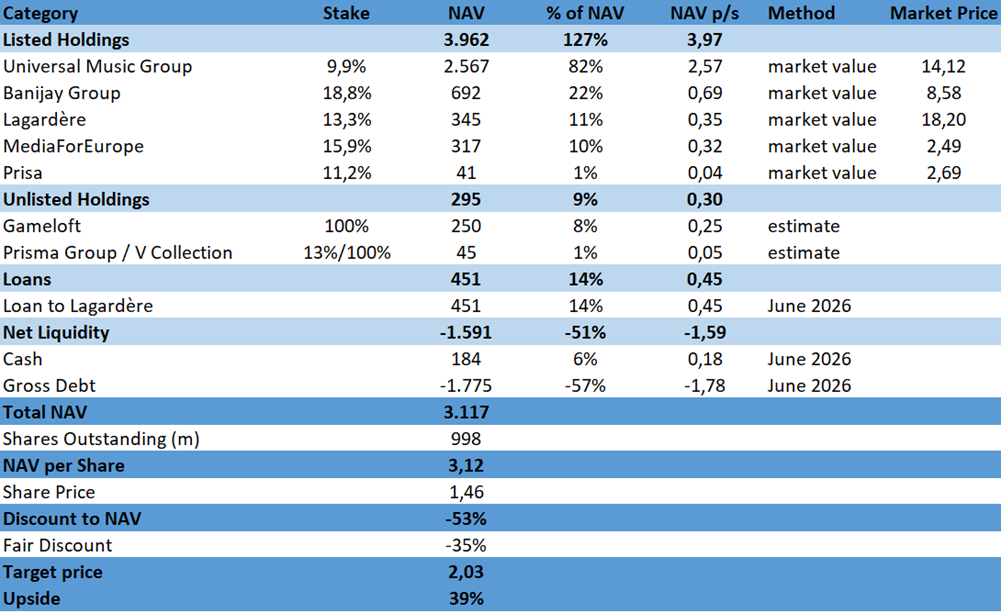
The calculation produces €3.117 billion of net asset value, or €3.12 per share. Against €1.46, that means paying about 47 cents for each euro of net assets.
The €451 million loan to Lagardère is included separately. It is a financial claim on Lagardère, distinct from the equity investment. Cash of €184 million and gross debt of €1.775 billion produce net debt of €1.591 billion.
UMG represents 82% of this net asset value. Its share of the gross portfolio is lower, but debt reduces the net value attributable to shareholders. That makes Vivendi particularly sensitive to changes in UMG’s share price.
Universal Music Group is the core asset
UMG is the world’s largest recorded music company and a major music publisher. It accounts for roughly a third of the global recorded music market. Its business is built around finding artists, developing their careers and earning income from music rights. Its catalog includes both current hits and recordings that people have listened to for decades.
Recorded music covers the rights to recordings. Music publishing covers the underlying compositions and lyrics. A song can generate revenue through streaming, physical sales, radio, live performances, advertising, films and other uses, with different rights involved in each case.
The attraction is the long life of successful music. A film is often watched once or twice. A favorite song can be played hundreds of times. A strong catalog can keep generating income long after the original recording and marketing costs have been incurred.
That does not make every release valuable. Many fail, and labels continually invest in new artists. But UMG spreads that risk across a huge portfolio, supported by global distribution, marketing relationships and the financial capacity to back talent.
Its scale also gives it bargaining power. A streaming platform would struggle to offer a compelling service without access to a large part of UMG’s repertoire. And while artists can now distribute music independently, reaching a global audience and building a lasting career still requires marketing, funding and industry relationships. Those are areas where the major labels remain valuable.
Streaming has made the business more recurring. Subscription payments reach rights holders each month, although the amounts still depend on contracts, listening patterns and the mix of markets. UMG benefits when paid subscriptions grow and when its content earns better terms.
Price increases are especially interesting. Music subscriptions remain inexpensive relative to the time many people spend using them. Agreements commonly described as Streaming 2.0 introduce better commercial terms, including increases in the wholesale prices platforms pay for music. They also create opportunities for additional paid features and experiences.
Emerging markets offer room for paid adoption, while superfans may spend more on access, merchandise and premium services. These opportunities can support growth without assuming that every existing customer will suddenly pay much more.
There are also costs behind the attractive catalog economics. Artists receive royalties and often substantial advances. Successful artists gain bargaining power when contracts are renewed. UMG must earn good returns on this spending, rather than simply report higher revenue.
The investment case rests on durable music rights, global scale and gradual improvements in monetization. Those features remain valuable even when quarterly growth disappoints.
Ackman’s failed proposal
In April 2026, billionaire investor Bill Ackman’s Pershing Square proposed merging UMG with its acquisition vehicle and moving the listing to New York. The standard terms offered €5.05 in cash and 0.77 shares in the new company for each UMG share. Pershing valued this package at €30.40 per share, although that figure depended on its valuation of the new shares. Shareholders could alternatively request €22 per share entirely in cash, but this option depended on enough other shareholders choosing shares instead. Cash allocations could be reduced if demand exceeded the available funds.

The proposal failed to win the necessary backing, with Bolloré publicly opposing the terms. UMG’s board rejected it in May, arguing that it materially undervalued the business and would not deliver superior value creation. Pershing subsequently sold its remaining stake in early June, removing a prominent shareholder and a potential catalyst.
I had stayed on the sidelines because I doubted Bolloré would support the transaction. But the failed proposal did not make UMG’s assets less valuable overnight. By September, Vivendi’s lower share price offered something more compelling to me: a valuation I found attractive without needing a takeover to succeed.
Why UMG has fallen so far
The selloff has several explanations. Investors have become less confident about streaming growth, margins and cash generation. AI has introduced another difficult question: will more music create more value for established rights holders, or dilute their share of listening?
The latest results gave investors reasons to be cautious. In the second quarter, recorded music subscription revenue grew 6.7% at constant currency excluding Downtown, against consensus expectations of roughly 9.3%. That was disappointing because new streaming agreements were already contributing higher wholesale prices. Investors had expected growth to accelerate.
First-half adjusted EBITDA declined 1.9% in reported euros, although it increased at constant currency. Free cash flow fell to €24 million from €163 million under the company’s revised definition. Some of the pressure relates to release schedules, working capital and investment. But a business with attractive long-term economics still has to turn its earnings into cash.
There is also a change in the type of revenue UMG earns. Distribution services, including the acquired Downtown business, are growing in importance. These contracts generally carry lower margins than traditional label agreements. They can require less investment, but they also leave UMG with a smaller share of revenue and can provide less favorable payment timing. Revenue growth therefore does not automatically translate into equally strong profit or cash flow growth.
AI deserves a balanced assessment. Cheaply generated music could compete for attention and put pressure on parts of the industry. Copyright protection alone does not remove every commercial risk.
However, more songs do not automatically mean less income for UMG. Its newer streaming agreements contain protections against purely AI-generated tracks diluting the royalty pool for human-created music. These protections matter, although they cannot fully protect the business if listeners eventually move to competing platforms or change their preferences.
At the same time, fans often want to engage with specific artists and familiar songs. Licensed remixes, personalized versions and other uses could create additional demand for established catalogs. On September 10, UMG announced a licensing and product-development agreement with ElevenLabs for a new music platform involving participating artists. The eventual financial contribution remains unknown, but it is a concrete example of how AI could create revenue as well as competition. UMG’s announcement
Shareholder uncertainty has added to the pressure. Potential sales by major shareholders and the postponed U.S. listing have complicated the investment story. The failure of Ackman’s proposal removed a potential catalyst, although Pershing Square’s subsequent exit also cleared a short-term selling overhang.
My view is that the market has become too pessimistic. But the recovery needs evidence, particularly in underlying growth and cash conversion.
The second discount
This brings me to the second layer of the investment case. Vivendi trades at a substantial discount to its estimated NAV, while its largest holding, UMG, also looks inexpensive.
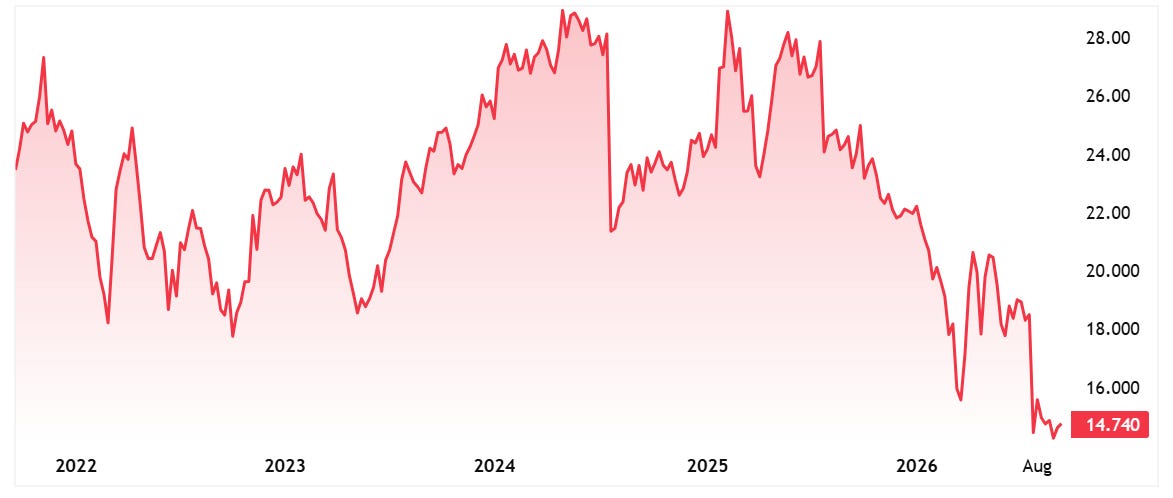
UMG’s €14.12 reference price is striking against its earnings. The company reported adjusted diluted earnings of €1.03 per share for 2025, putting the stock at approximately 13.7 times earnings.
That is a historical adjusted earnings multiple. It excludes items such as non-cash share-based compensation and catalog amortization. Share awards still have an economic cost, so I would not treat adjusted earnings as identical to cash available to shareholders.
The Bloomberg chart below puts the valuation in a longer-term context. It shows UMG’s forward price-to-earnings ratio and its price-to-sales ratio over roughly five years. The latest readings shown are approximately 14 times expected earnings and 2 times trailing annual sales.
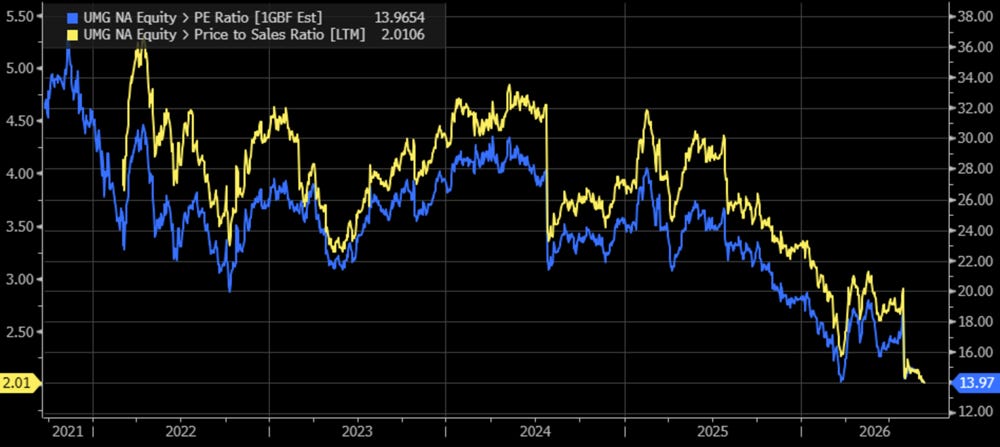
Both measures are at their lowest levels since UMG’s 2021 IPO. For much of that period, investors paid roughly 25–30 times expected earnings and 4 times annual sales. UMG now trades at a much lower valuation relative to both its revenue and its expected profits.
A lower multiple does not guarantee a bargain. Earnings forecasts can fall further, and lower margins can justify a lower price-to-sales ratio. I would not assume that UMG must return to its old valuation. But the chart shows how far expectations have already come down.
Furthermore, UMG also owns a stake in Spotify, the music streaming platform. Its remaining holding was approximately 2.6% at the end of June, worth around €2.55 billion at Spotify’s current market cap. In April UMG announced that it would sell half its original (then 3%) holding. After taxes and payments to artists, UMG intends to use its share of the proceeds for share buybacks. Repurchasing UMG shares at a low valuation could increase value per share, providing another potential catalyst alongside a recovery in the music business.
The current valuation looks modest for a market leader with recurring income, valuable rights and opportunities to grow. UMG does not need to achieve the most optimistic analyst forecasts to justify a meaningfully higher valuation.
My Vivendi valuation does not require such a recovery. The starting point is the asset valuation in the NAV table. An improvement in UMG’s value would come on top of the existing gap between Vivendi’s share price and estimated NAV.
Using the UMG holding value in that table, a 20% increase would add roughly €513 million, or €0.51 per Vivendi share, with everything else unchanged. Estimated NAV would rise from €3.12 to about €3.64. A recovery in UMG could therefore increase Vivendi’s underlying value even if its holding discount remained wide.
The Bolloré family
Vincent Bolloré is the French billionaire businessman who transformed the family’s industrial business into an international logistics and media empire. Two of his sons now hold key leadership roles: Cyrille Bolloré chairs and runs Bolloré SE, while Yannick Bolloré runs Havas and chairs Vivendi’s supervisory board.
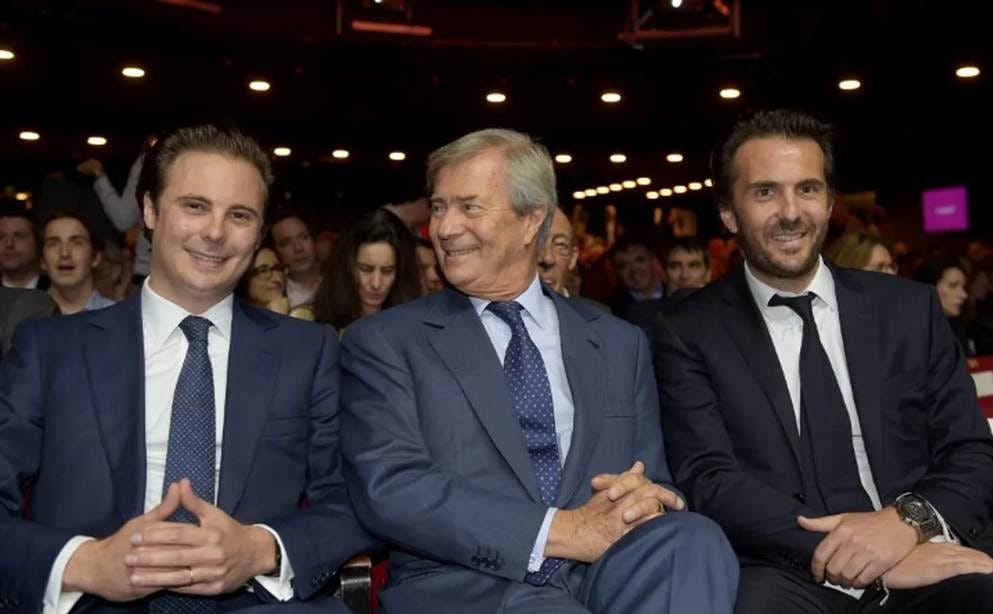
Vincent is also a controversial figure in French public life. His family’s media interests span television, radio, newspapers, magazines and book publishing, giving it several ways to reach audiences and shape public debate. His conservative Catholic convictions and this concentration of media influence attract considerable scrutiny. Critics argue that outlets such as CNews and Le Journal du Dimanche promote hard-right views and help normalize Marine Le Pen’s National Rally (RN). Their ability to shape the political agenda has drawn particular attention ahead of France’s 2027 presidential election, although their impact on voting outcomes is difficult to measure.

Bolloré rejects accusations of pursuing a political agenda and says he does not interfere in programming. For minority shareholders, my concern is that media influence and personal convictions may carry value for the family beyond financial returns. That could affect its willingness to sell assets or simplify the structure, even when doing so might benefit outside investors. His reputation could also potentially give him and his companies a disadvantage in legal case.
The Bolloré universe
Vivendi belongs to the wider “Bolloré universe”: a network of listed holding companies and overlapping stakes built around the Bolloré family. Compagnie de l’Odet controls Bolloré SE, which holds significant interests in Vivendi, UMG, Canal+, Havas and Louis Hachette Group. The chart below shows the group structure, which got simplified in het past few years.
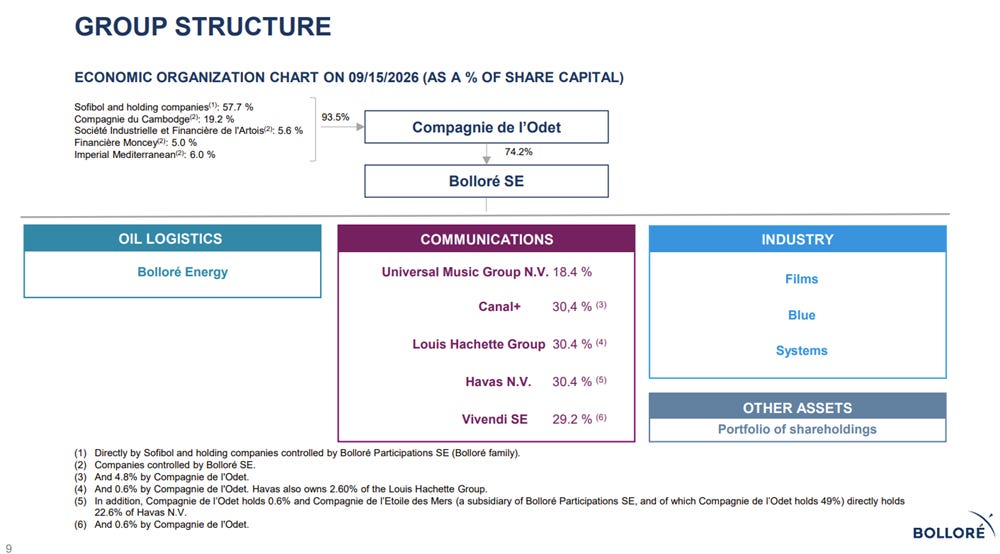
Bolloré SE owns roughly 30% of Vivendi and a direct stake of around 18% in UMG. The family has a clear economic interest in these assets, but its preferred timing and structure for realizing their value may differ from those of outside shareholders.
Who’s really in control?
The distinction between influence and legal control became central to the dispute following Vivendi’s December 2024 breakup. CIAM (an activist investment fund and minority shareholder in Vivendi) argued that Bolloré effectively controlled the company. It claimed that shareholders should therefore have been offered an opportunity to exit through a public buyout offer before such a fundamental restructuring.
Bolloré’s stake remained below the usual 30% threshold for a mandatory takeover bid. But the case concerned whether it nevertheless exercised effective control, making the breakup subject to separate rules protecting minority shareholders. Staying below 30% did not, by itself, settle that question.
In April 2025, the Paris Court of Appeal found that Bolloré exercised control. The French market regulator, the AMF, subsequently required a public buyout offer within six months.
This raised the prospect of a compulsory offer substantially above Vivendi’s market price. Investors hoped the price would reflect the underlying assets more closely. Barclays, for example, illustrated a bid value of roughly €4 per share, based on its NAV estimate at the time. This was an analyst scenario, not a guaranteed offer price.
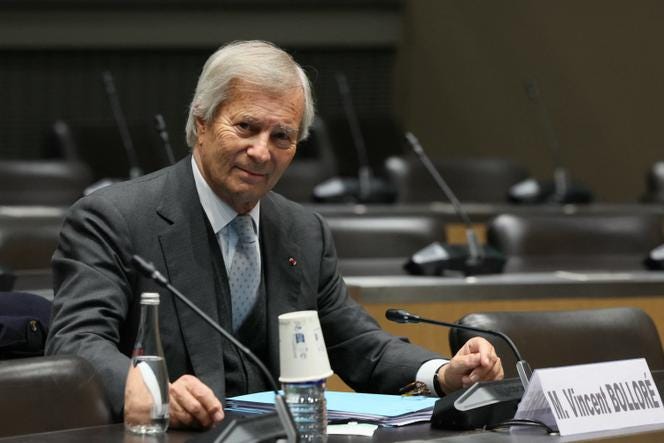
The legal position then changed. In November 2025, France’s highest civil court overturned the relevant control finding. It ruled that the test had to focus on voting rights and the ability to determine shareholder decisions. Vincent Bolloré’s reputation and wider influence were insufficient grounds on their own.
On July 8, 2026, the Court of Appeal ruled that Bolloré did not control Vivendi under the relevant legal definition. CIAM appealed again on July 27, so the dispute remains unresolved. However, I would not base the investment case on a mandatory offer. It seems unlikely at the moment. A voluntary offer remains a separate possibility, with its timing and terms largely in Bolloré’s hands.
Why the discount exists
There are good reasons for Vivendi to trade below NAV. Minority shareholders cannot force the company to sell its investments and distribute the proceeds. They depend on management’s decisions, and the Bolloré family’s priorities may not include quickly closing the discount.
Vivendi also carries the costs of a corporate organization. Recurring corporate costs were €45 million in the first half of 2026, down from €52 million. A restructuring affecting about 40% of headquarters staff should produce further savings. Management has targeted a roughly 20% reduction in annual corporate costs by 2027 from the €99 million reported in 2025, implying savings of around €20 million. The remaining expense of around €79 million would still be meaningful for a company of this size: 2.5% of NAV. These high overheads partly reflect a structure inherited from before the breakup, when Vivendi was a much larger group.
I have not deducted the capitalized value of these costs in the NAV table. They are nevertheless a real expense and one reason why a larger holding discount is justified. If you use a multiple of 5x, it would detract €400 million from NAV or €0.40 per share.
Management is also making new investments. The €40 million spent on V Collection and Prisma Group shows that Vivendi is being run as an ongoing investment business. Investors should not assume an imminent liquidation.
Another risk is the European Commission’s investigation into the Lagardère acquisition. The Commission alleges that Vivendi implemented the transaction before the required approvals, commonly called gun-jumping. A supplementary statement of objections was issued in July 2026, and the proceedings remain unresolved.
Several sell-side analysts I have spoken with estimate a potential fine of around €100 million. This is their estimate, not an official amount or a ceiling. The relevant rules allow fines of up to 10% of the sanctioned company’s worldwide turnover. Depending on the applicable turnover base, the theoretical exposure could therefore be much larger.
A €100 million fine would reduce NAV by roughly €0.10 per share. That would be manageable within the valuation, although a substantially larger penalty could change the calculation. No deduction for this potential fine is included in the main NAV table.
What could unlock the value
I see four main routes to a higher share price. They can reinforce one another, although investors should avoid counting the same benefit twice.
The first is a narrower holding discount. A move from 53% to 35%, with the portfolio unchanged, would imply approximately €2.03 per share, or 39% upside. A 35% discount still leaves a substantial allowance for costs, governance and uncertainty. I use it as a reasonable valuation assumption, while recognizing that the market can maintain a wider discount for years.
The second is a recovery in UMG. Better results, stronger cash generation or more confidence in future growth could lift Vivendi’s NAV even if its holding discount remains wide. This gives the investment a source of return that does not depend on a corporate transaction.
The third is a voluntary offer from Bolloré. The family could buy Vivendi at a premium to its share price while still paying below NAV, increasing its exposure to familiar assets and removing duplicated costs. Recent exceptional dividends could help finance further simplification of the wider group. Bolloré SE distributed €4.2 billion in June, and on September 16, Compagnie de l’Odet announced a €2.5 billion distribution of its own. These payments move cash through the holding structure, potentially providing funds to buy out outside shareholders in listed companies within the Bolloré universe. Vivendi is one possible candidate, although no offer or timetable has been announced.
The fourth is an offer from another party for Vivendi or UMG. Such a transaction would face considerable ownership and governance obstacles. Nevertheless, Ackman’s approach showed that an outside investor could see value and propose a transaction to realize it.
A future bidder would need to solve those problems. I assign no specific takeover premium in my €2.03 valuation. The possibility is additional upside, with considerable uncertainty attached.
Cost reductions, sensible disposals and disciplined capital returns could also help. Asset sales will not necessarily fund immediate buybacks, however. Vivendi’s financing agreements can require proceeds to repay secured debt or provide collateral.
Valuation scenarios and what would change my mind
The matrix below shows how changes in UMG’s share price and Vivendi’s holding discount could affect the return from my €1.46 purchase price. The columns show different outcomes for UMG, while the rows show the discount applied to Vivendi’s resulting NAV.

My reference valuation requires no recovery in UMG. With its share price unchanged and Vivendi’s discount narrowing to 35%, the implied Vivendi share price is approximately €2.03, offering 39% upside.
A recovery in UMG would add to that potential. A 20% rise in UMG would produce around 12% upside even with Vivendi trading at a 55% discount, slightly wider than today (53%). If the same UMG price recovery coincided with a 35% discount, the upside would reach approximately 62%.
The downside scenarios matter too. A 10% decline in UMG combined with a widening of Vivendi’s discount to 60% would imply a loss of around 21%. These are selected scenarios, not limits on the possible outcomes. A large discount provides a valuation cushion, but it does not prevent further losses. But I consider a sustained widening of the discount beyond 60% unlikely. I don’t see much downside in UMG’s historically low valuation either.
Timing also matters. The 39% upside to approximately €2.03 would represent roughly 12% annually if achieved over three years, before dividends. Taking much longer would reduce that annual return, while ongoing costs could erode the asset value.
Debt requires attention as well. Part of Vivendi’s portfolio is pledged against financing that can require additional collateral when asset prices fall. The main structured facilities were extended to September 2027. A wide discount does not remove refinancing risk.
I would reconsider the investment if UMG’s weaker cash generation proved structural, if management repeatedly invested at poor returns, or if debt and legal liabilities forced unfavorable asset sales. A persistently wide discount would also weaken the case for owning Vivendi instead of UMG directly.
For now, the price is what makes the uncertainty acceptable to me. At €1.46 against an estimated €3.12 of NAV per share, Vivendi provides exposure to a valuable core asset that I believe is itself undervalued. My €2.03 reference valuation still assumes a sizable holding discount, an unchanged UMG share price and no takeover. That is enough to make Vivendi an attractive deep-value investment in my view.
A well-crafted summary of the main issues, good job!
Such a great analysis!