
Sometimes, value hides in plain sight.
In a market obsessed with AI hype and high-growth stories, one of the most profitable, cash-generating fintechs in the world trades at single-digit multiples of free cash flow.
That company is PayPal Holdings (PYPL).
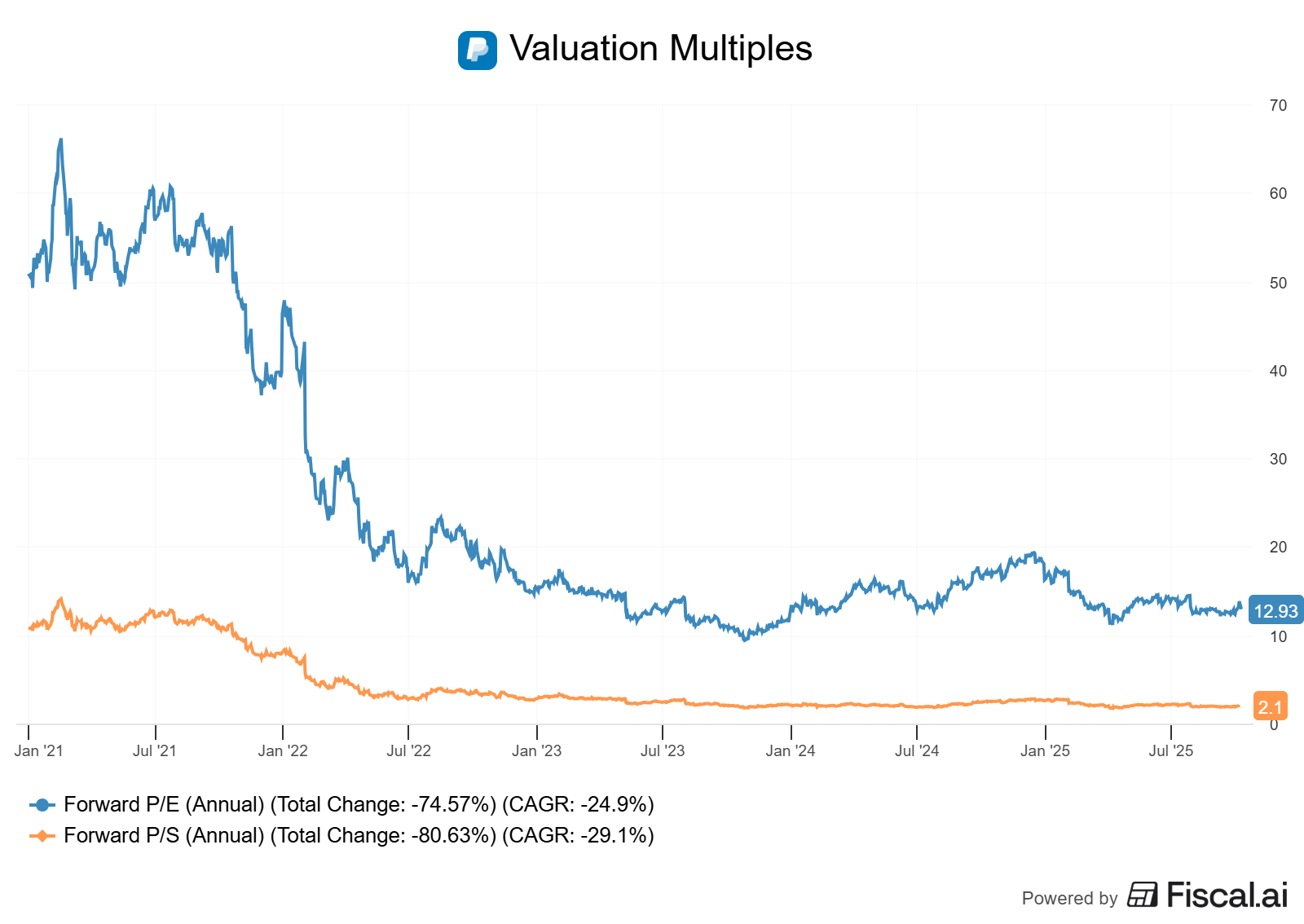
At today’s price near 69 USD, PayPal trades at a forward P/E of 13.8 and a forward P/FCF ratio of just 9.2 — levels more typical of slow-growing industrials than a global payments leader with over 430 million active accounts. Morningstar estimates a fair value of 94 USD, implying 36% upside, and still calls PayPal’s moat “narrow but durable.”
But the real story isn’t only the valuation. It’s what PayPal is quietly doing with its mountain of cash.
A 20 Billion USD Buyback Engine
PayPal has one of the largest and most aggressive share repurchase programs in corporate America.
The company’s 20 billion USD buyback authorization, approved in 2022, represents roughly 30% of its current market capitalization.
Over the past 12 months alone, PayPal repurchased 9.1% of its shares outstanding — a buyback yield of 9.1%, far higher than Apple, Visa, or Mastercard. Management still has more than 12 billion USD remaining under the current authorization, and with annual free cash flow exceeding 6–7 billion USD, the company can comfortably sustain these repurchases for years to come.
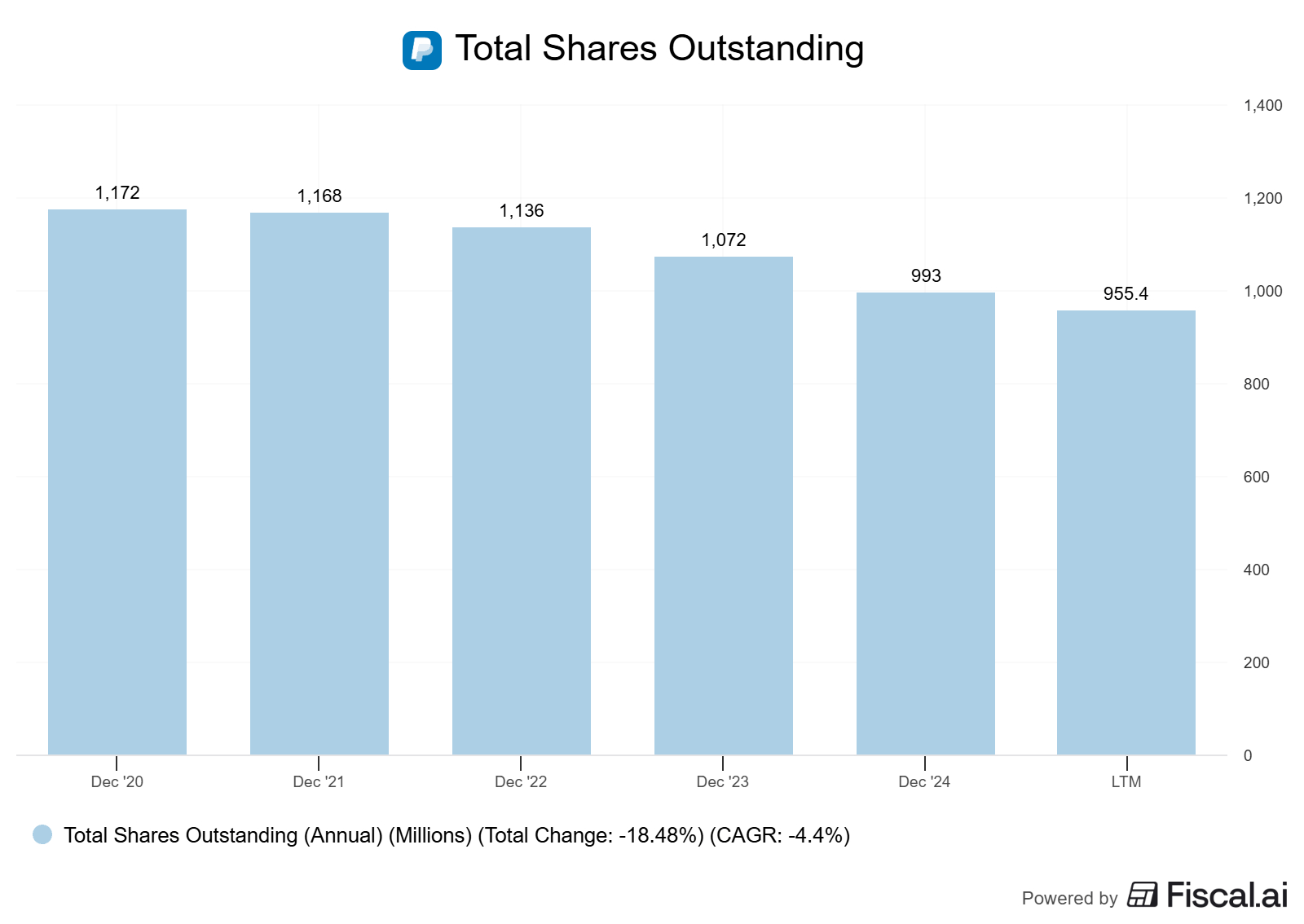
Buybacks of this magnitude do more than shrink the share count. They supercharge earnings per share (EPS) growth, giving long-term investors an ever-larger claim on PayPal’s profits even if revenue grows modestly.
It’s a rare combination: low valuation, high cash generation, and consistent capital returns.
A silent compounding machine
This buyback yield of 9.1% effectively turns PayPal into a compounding machine.
Each year, the denominator (shares outstanding) shrinks, magnifying per-share metrics. Over time, EPS rises faster than earnings — and intrinsic value compounds quietly in the background.
It’s the same math that made Apple and AutoZone legendary compounders — except PayPal trades at a single-digit FCF multiple.
And crucially, the balance sheet supports it: minimal debt, strong cash flow, and a disciplined focus on profitable growth.
The new PayPal under Alex Chriss
When Alex Chriss took over as CEO in late 2023, he inherited a company struggling with post-pandemic fatigue and fierce competition from Apple Pay, Stripe, and Adyen.
His message since then has been clear: “Focus on what’s profitable.”
In the most recent earnings call, Chriss described how PayPal is being reshaped from a simple payments processor into a “dynamic commerce platform.”
Key priorities include:
Winning checkout through faster, frictionless payment experiences.
Scaling Venmo from peer-to-peer payments into an everyday shopping tool.
Driving Braintree profitability, now past its margin reset phase.
Launching PayPal World, a global wallet platform connecting billions of users across PayPal, Venmo, Mercado Pago, Tenpay Global and India’s UPI.
This is the new PayPal: leaner, more disciplined, and built to thrive even in a slower economy.
The numbers behind the value
Morningstar projects 6% annual revenue growth over the next five years and steady margin improvement of 25 basis points per year as scale effects kick in.
The company now trades at just 2.1× sales — compared to Visa’s 17× and Mastercard’s 16×.
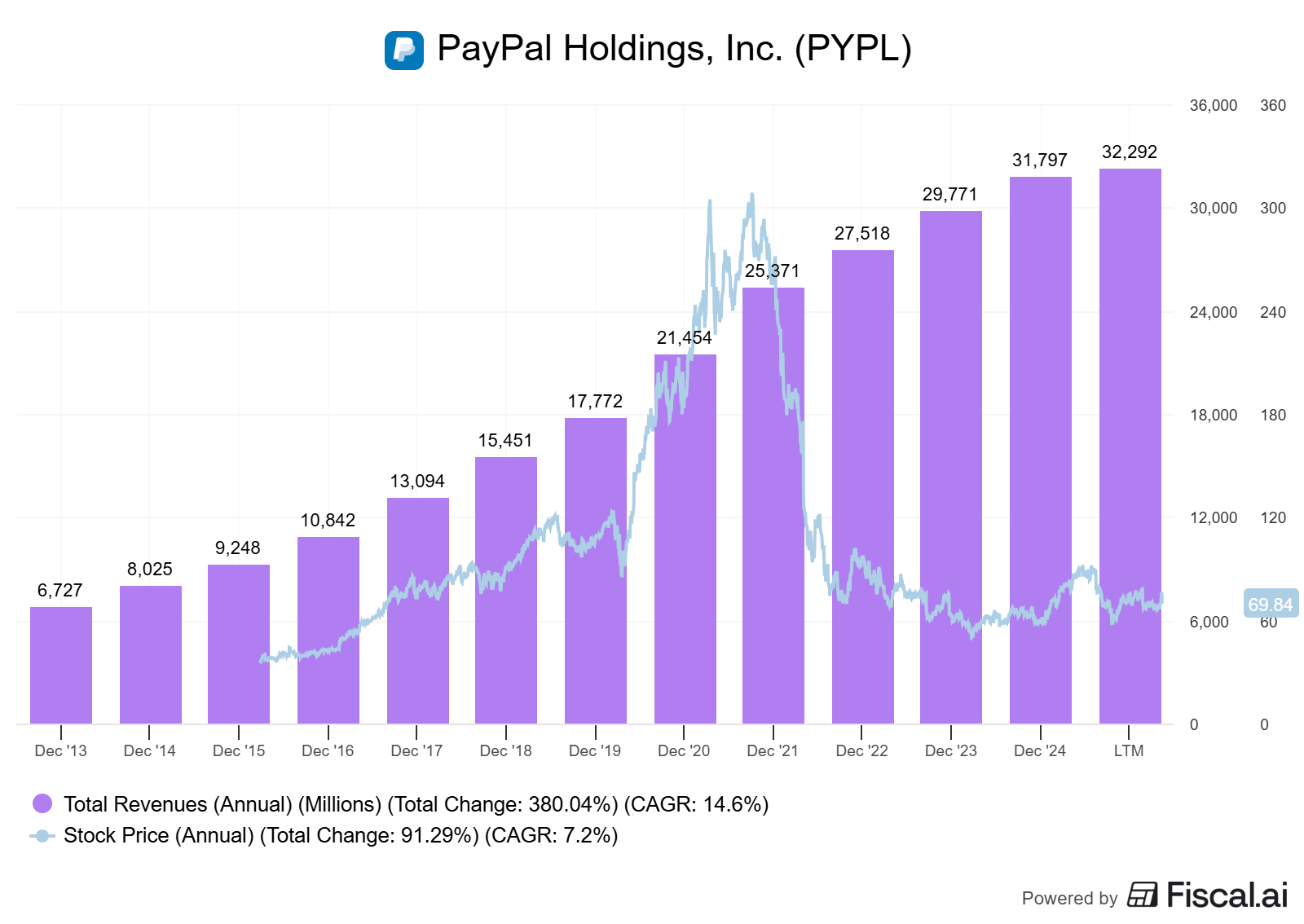
Despite losing eBay as a high-margin partner years ago, PayPal has rebuilt profitability. In Q2 2025, non-GAAP EPS rose 18% year over year, and transaction margin dollars grew 8%.
Those are hardly the metrics of a business in decline.
PayPal’s return on invested capital remains far above its cost of capital — the hallmark of a durable cash compounder.
Why the market is wrong
Investors have been skeptical for two main reasons:
Competition — Apple Pay, Alipay, and WeChat Pay dominate their ecosystems.
Slower active user growth — account expansion stalled after 2022.
But the fears are overstated. PayPal still processes over 1.7 trillion USD in annual payment volume, enjoys near-90% checkout conversion rates (vs. industry average ~50%), and has embedded relationships with millions of merchants.
Venmo is finally showing traction, with revenue up 20% and total payment volume up 12%, its best performance in three years.
Meanwhile, the company’s massive user base and brand trust remain enormous moats — assets new competitors can’t easily replicate.
Optionality: crypto, AI and beyond
Chriss is quietly positioning PayPal for the next decade of digital commerce.
Recent moves include:
Acquiring a 40% stake in Binance Japan, signaling deeper entry into crypto.
Partnering with Google to integrate PayPal’s solutions across its platforms.
Expanding PYUSD, its U.S. dollar-backed stablecoin, for decentralized finance and cross-border payments.
These are early steps, but they show a willingness to innovate — without sacrificing profitability.
Risks
No investment is without them. PayPal remains exposed to:
Regulatory risk, especially around crypto and global data security.
Competition from tech giants with built-in ecosystems.
Macro headwinds affecting discretionary online spending.
But management has already proven capable of adapting. The company’s scale, brand, and global reach are difficult to replicate — and its financial flexibility is a major buffer.
The bottom line
PayPal today trades at 9× free cash flow, 13.8× forward earnings, and buys back around 9% of its shares every year — under a 20 billion USD repurchase authorization — nearly a third of the current market cap.
That combination is rare — and powerful.
In a market where investors are paying 30–40× earnings for growth stories with no cash flow, PayPal quietly delivers both growth and cash.
The narrative may still be broken, but the business isn’t.
I’ve owned PayPal for quite some time, but recently increased my position significantly. Anything below 75 USD looks extremely attractive to me — and below 70 USD feels like a genuine bargain.
Markets can stay blind to value for a while. That’s fine. Compounding prefers silence.
— Deep Value Stocks