
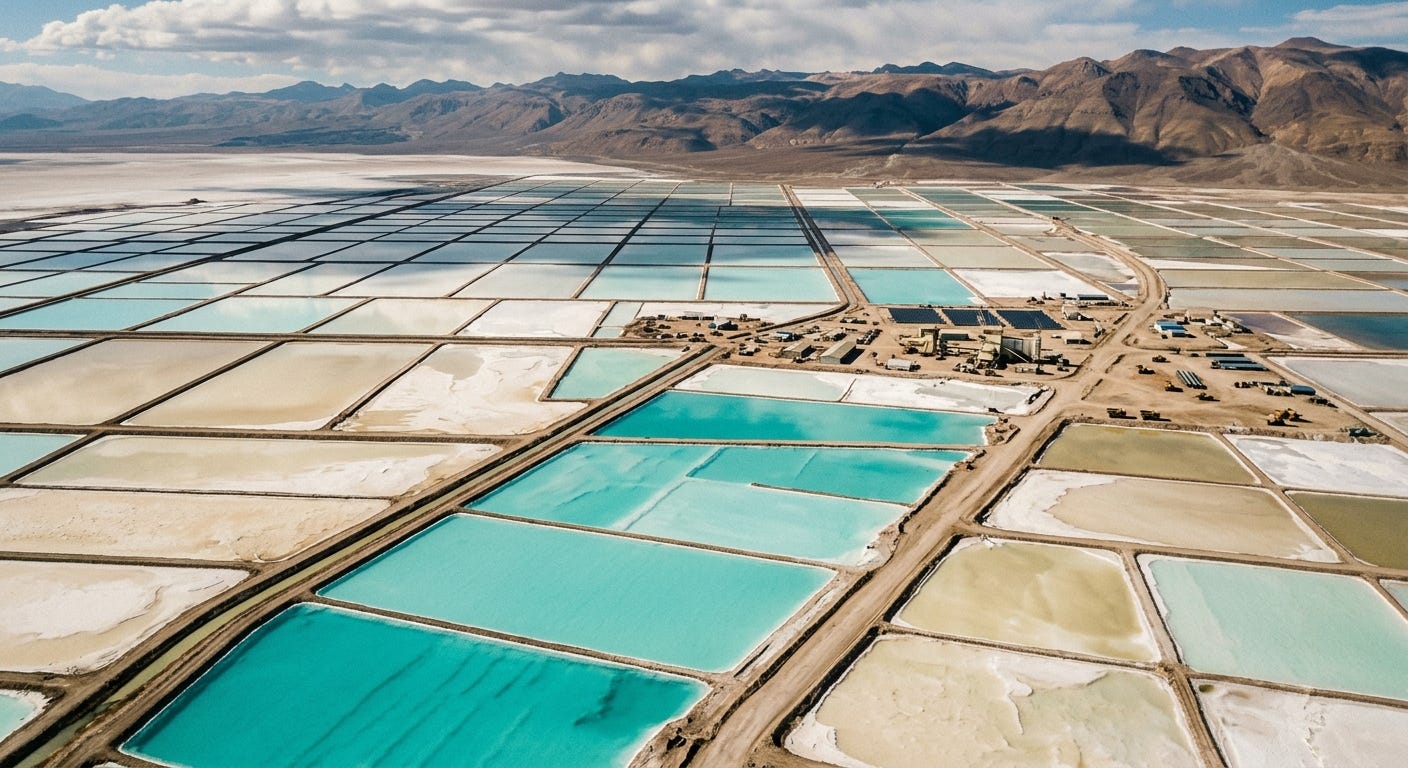
About a year ago, I first wrote about Lithium Chile as one of the more unusual special situations I had come across in the junior mining space.
The investment case was relatively straightforward.
Lithium Chile owned a large, advanced lithium project in Argentina called Salar de Arizaro. In late 2024, the company received an offer to sell its interest in the project for an amount that was substantially higher than Lithium Chile’s entire market capitalization.
Since then, the story has progressed considerably.
The initial letter of intent eventually became a definitive $175 million cash transaction with China Union Holdings. The buyer paid a $5 million deposit. Shareholders overwhelmingly approved the transaction. Several regulatory and operational hurdles were cleared.
And yet, today Lithium Chile trades at approximately CAD 0.43 per share, giving the entire company a market capitalization of only around CAD 95 million, or roughly $69 million.
That means the agreed sale price for Arizaro alone is approximately 2.5 times Lithium Chile’s entire market capitalization.
Normally, that would look absurdly cheap for a company with no debt. There is, however, a catch. And this week that catch became considerably more important.
Let’s start with Arizaro
Lithium Chile is a Canadian-listed lithium exploration company with projects in Chile and Argentina.
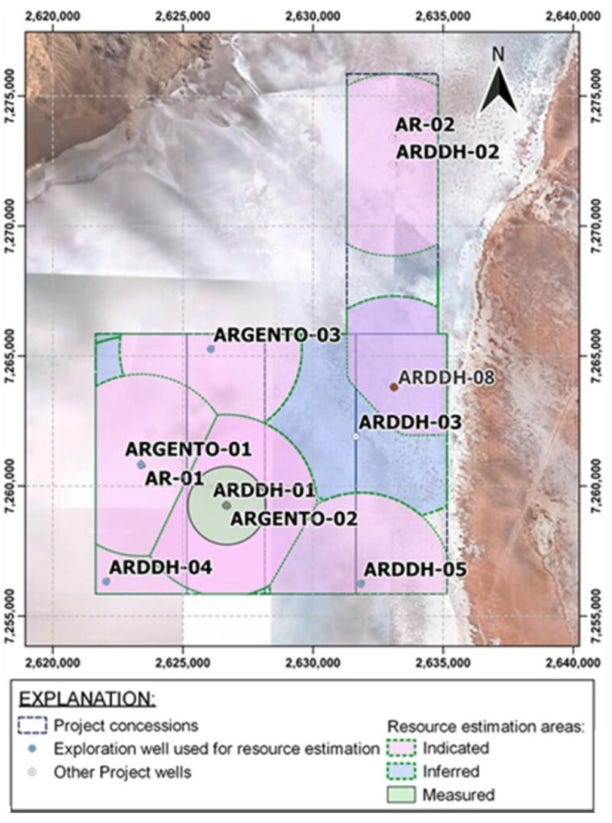
Its flagship asset is the Salar de Arizaro project in Salta Province, Argentina.
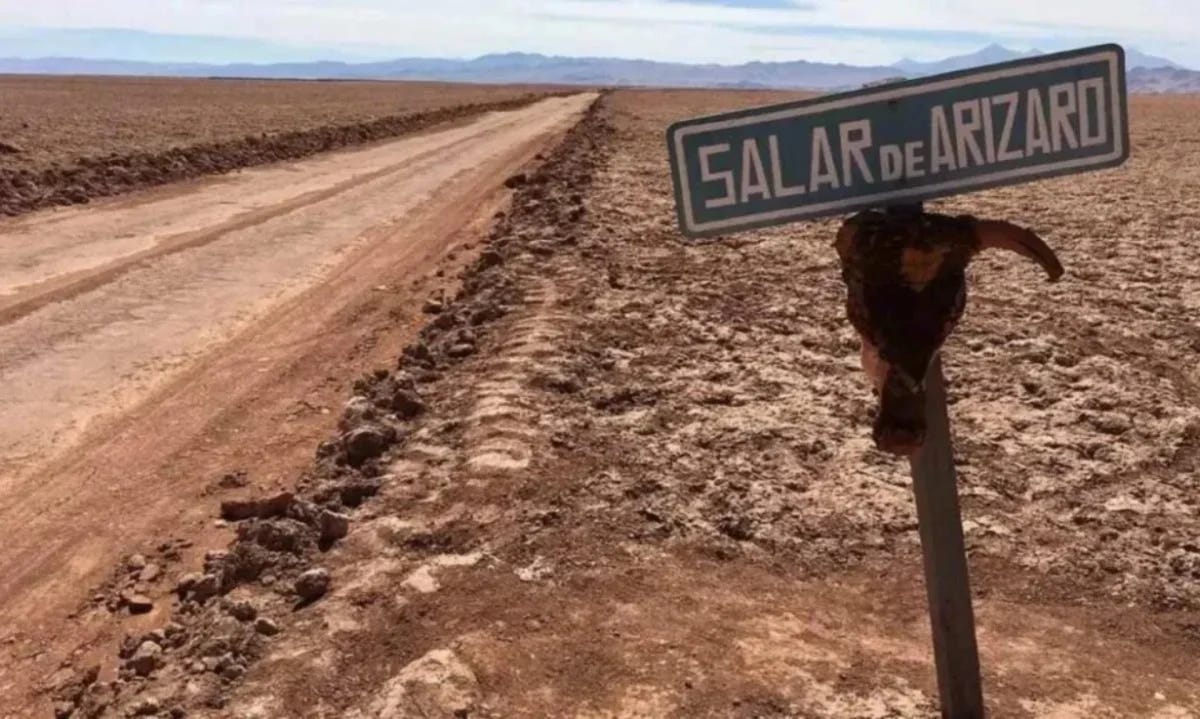
This is not simply an early-stage exploration property with a few promising drill holes.
Lithium Chile has completed an NI 43-101 resource estimate, a Preliminary Economic Assessment and a Pre-Feasibility Study on Arizaro.
The project has an estimated resource of approximately 4.12 million tonnes of lithium carbonate equivalent (LCE).
The PFS contemplated production of 25,000 tonnes of battery-grade lithium carbonate per year over a 20-year mine life. Based on the assumptions used in that study, Arizaro had a pre-tax NPV8 of approximately $3.85 billion and an IRR of 42.1%.
I would not attach too much importance to that headline NPV. Lithium project economics are extremely sensitive to the assumed lithium price, and developing Arizaro would require more than $1 billion of initial capital.
For me, there is a much more important valuation datapoint: someone is actually willing to pay $175 million in cash for the asset.
That is no longer a theoretical valuation in an Excel spreadsheet. There is a signed definitive agreement.
From an LOI to a $175 million definitive agreement
The story began in December 2024, when Lithium Chile signed a binding letter of intent to sell its interest in Arizaro.
The prospective buyer was willing to pay $180 million for the project.
After a long negotiation process, the company eventually signed a definitive agreement with China Union Holdings on December 22, 2025. The final agreed purchase price was slightly lower, at $175 million in cash, equivalent to roughly CAD 250 million.
Since then, several important steps have been completed.
China Union paid a $5 million deposit in February.
The necessary approvals in Salta Province were obtained.
And in May, Lithium Chile shareholders voted overwhelmingly in favour of the transaction, with approximately 96% of votes cast supporting the sale.
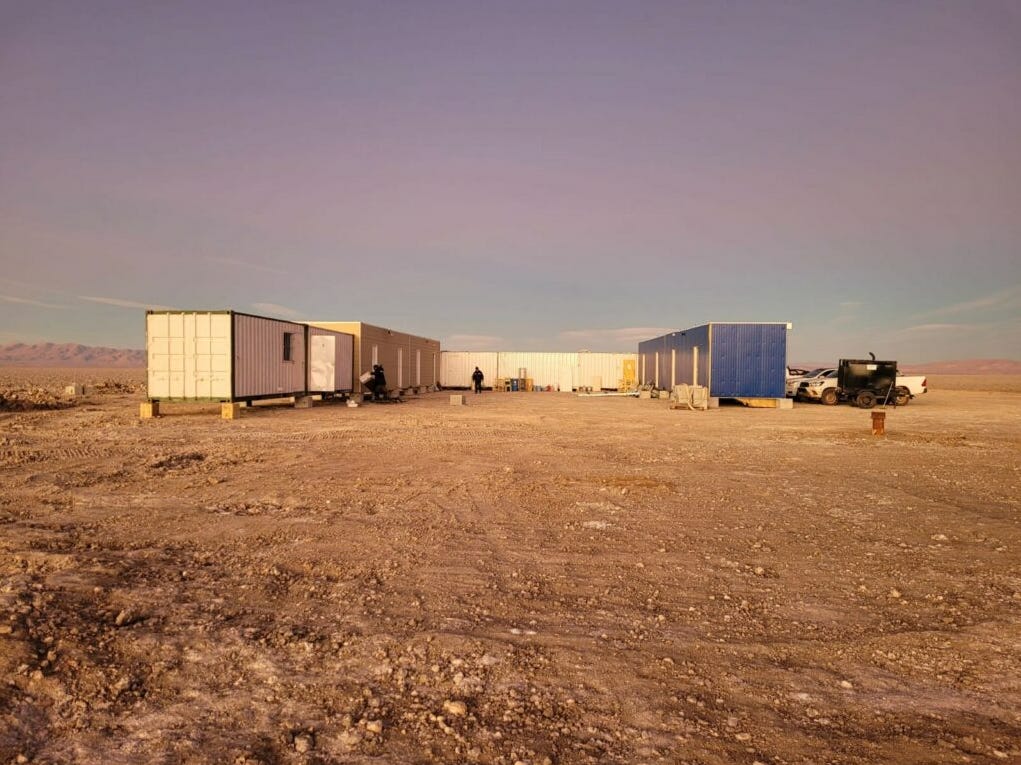
China Union has also behaved like a buyer that genuinely intends to develop the project. Technical teams and engineers have already visited Arizaro and preparations for the project have continued.
So this is much more than an expression of interest.
The problem is that the money has still not arrived.
First problem: getting the money out of China
One of the remaining conditions is Chinese outbound direct investment approval.
China Union needs permission to transfer the funds out of China to complete the acquisition.
That process took longer than expected.
In June, Lithium Chile and China Union therefore extended the transaction’s deadline by 60 days to August 20, 2026, with the agreement allowing another extension if necessary.
China Union requiring more time was not necessarily a major red flag. China maintains capital controls and large overseas investments require government approval. The company stated that the approval process was progressing. China Union had also already paid its deposit and sent engineers and technical specialists to the project.
Until recently, this looked like the principal obstacle to closing.
Then Canada entered the picture again.
Canada just changed the equation
On August 17, Lithium Chile announced that both the company and China Union had received a notice under subsection 25.2(1) of the Investment Canada Act.
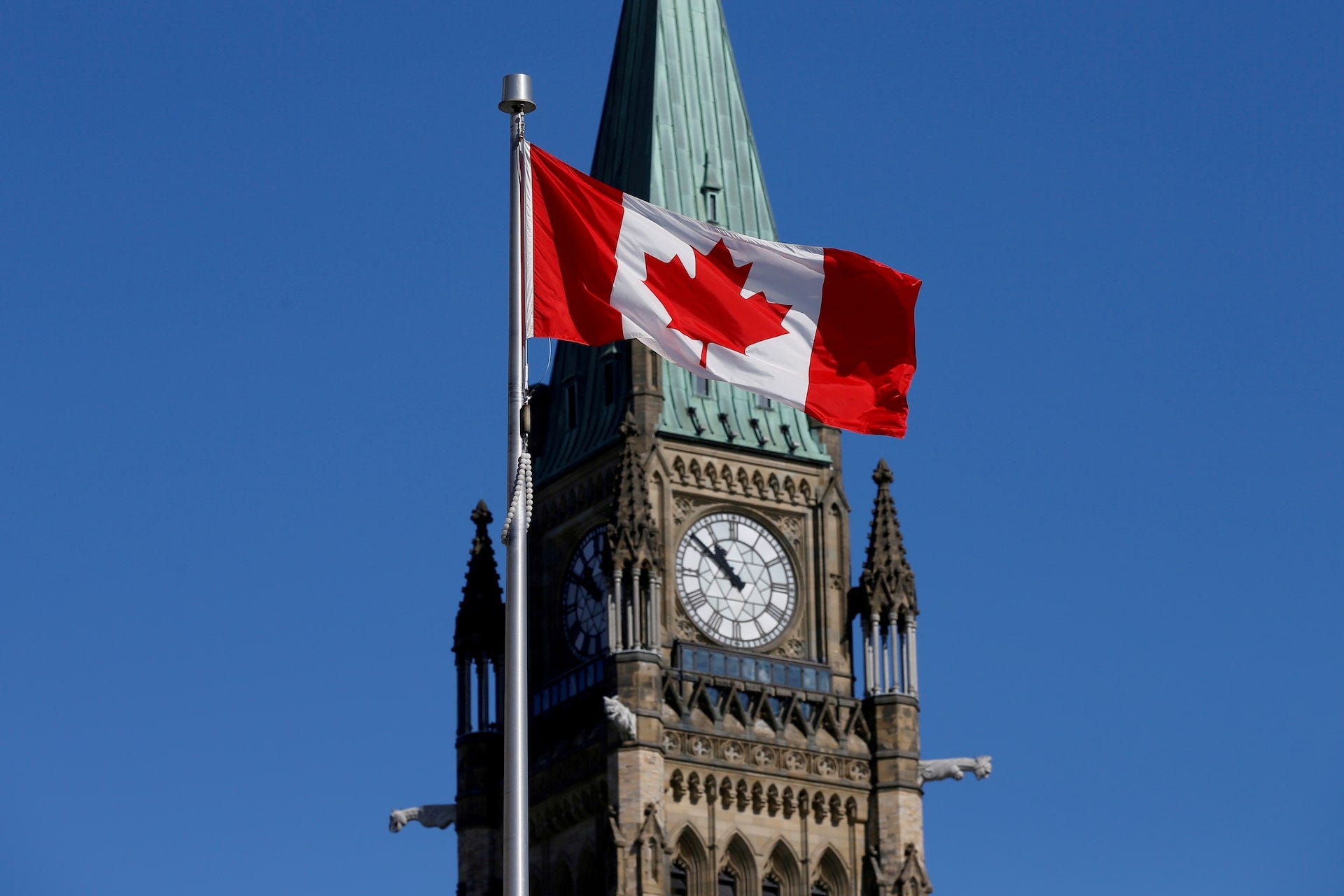
The notice states that Canada’s Director of Investments has reasonable grounds to believe that the transaction could be injurious to Canadian national security.
Canada may consequently order a further national-security review.
That distinction is important.
A full national-security review has not yet been ordered.
But the notice introduces a new and potentially significant obstacle to the transaction, and the deal cannot simply proceed while the relevant Investment Canada Act process is unresolved.
If Canada decides to proceed with a full review, the process could take several additional months. Under the legislation, a formal review can run for up to 90 days and can potentially be extended.
Lithium Chile strongly disputes Canada’s jurisdiction. And there is an obvious reason why. Arizaro is not located in Canada. It is in Argentina.
The company being sold, Argentum Lithium, is an Argentine corporation. According to Lithium Chile, Argentum owns no Canadian assets, has no Canadian employees and has no place of business in Canada.
Lithium Chile had already written to the Canadian authorities in January to make its position clear. Nevertheless, Ottawa has now raised national-security concerns more than half a year later.
That makes the coming months considerably more interesting.
Unfortunately, the Canadian risk is real
It would be easy for a bullish investor to dismiss Ottawa’s intervention because the underlying asset is in Argentina.
I don’t think that would be sensible. There is an uncomfortable precedent here.
In 2022, the Canadian government ordered Chinese investor Chengze Lithium International to divest its investment in Lithium Chile as part of Canada’s crackdown on foreign investment in critical minerals.
In other words, Canada has already intervened once in a Chinese investment involving this exact company.
Lithium is considered a strategic critical mineral, and political scrutiny of Chinese control over critical-mineral supply chains has only increased.
This risk was already known when the definitive agreement was signed. The principal outstanding condition highlighted at the time was Canadian approval, precisely because Lithium Chile had previously been caught up in Canada’s tougher policy toward Chinese investment in critical minerals.
So the discount in Lithium Chile’s share price is not irrational. The market has a legitimate reason to question whether China Union will ever be allowed to complete the transaction.
The more interesting question is whether that discount has become too large.
$69 million versus $175 million
This is where the valuation becomes fascinating.
At approximately CAD 0.43 per share, Lithium Chile has a market capitalization of roughly $95 CAD million, or approximately $69 million. China Union has signed a definitive agreement to pay $175 million in cash for Arizaro. The agreed purchase price is therefore roughly 2.5x Lithium Chile’s entire current market capitalization. Put differently, Lithium Chile’s entire equity value currently represents only around 39% of the headline value of the Arizaro transaction.
Of course, $175 million does not equal $175 million distributable to shareholders. There will be taxes, transaction expenses and other adjustments. At closing, 7.5% of the purchase price is also initially placed into escrow. And Lithium Chile does not intend to distribute every dollar.
Management has indicated that it intends to return the majority of the proceeds to shareholders, potentially through a Substantial Issuer Bid, while retaining capital to develop the company’s remaining portfolio.
So simply dividing $175 million by the number of shares and calling the result “fair value” would be misleading. But the valuation gap is so large that you can apply substantial haircuts and still arrive at an interesting result.
Suppose, purely for illustration, that only $120 million of value ultimately becomes available for distributions or share repurchases. That alone would still represent approximately 1.7 times today’s entire market capitalization. And that calculation assigns zero value to everything Lithium Chile owns after selling Arizaro.
But there is another important detail that makes this valuation gap even more interesting.
The $175 million price was negotiated in a very different lithium market
The $175 million transaction price should not really be viewed as a fresh 2026 valuation of Arizaro. Its origins go back to late 2024.
Lithium Chile signed the original binding LOI in December 2024, when the prospective buyer was prepared to pay $180 million for Lithium Chile’s interest in Arizaro.
That matters because the lithium market looked very different then. Chinese lithium carbonate prices were roughly around CNY 75,000–80,000 per tonne at the time. Today, they are around CNY 150,000 per tonne.
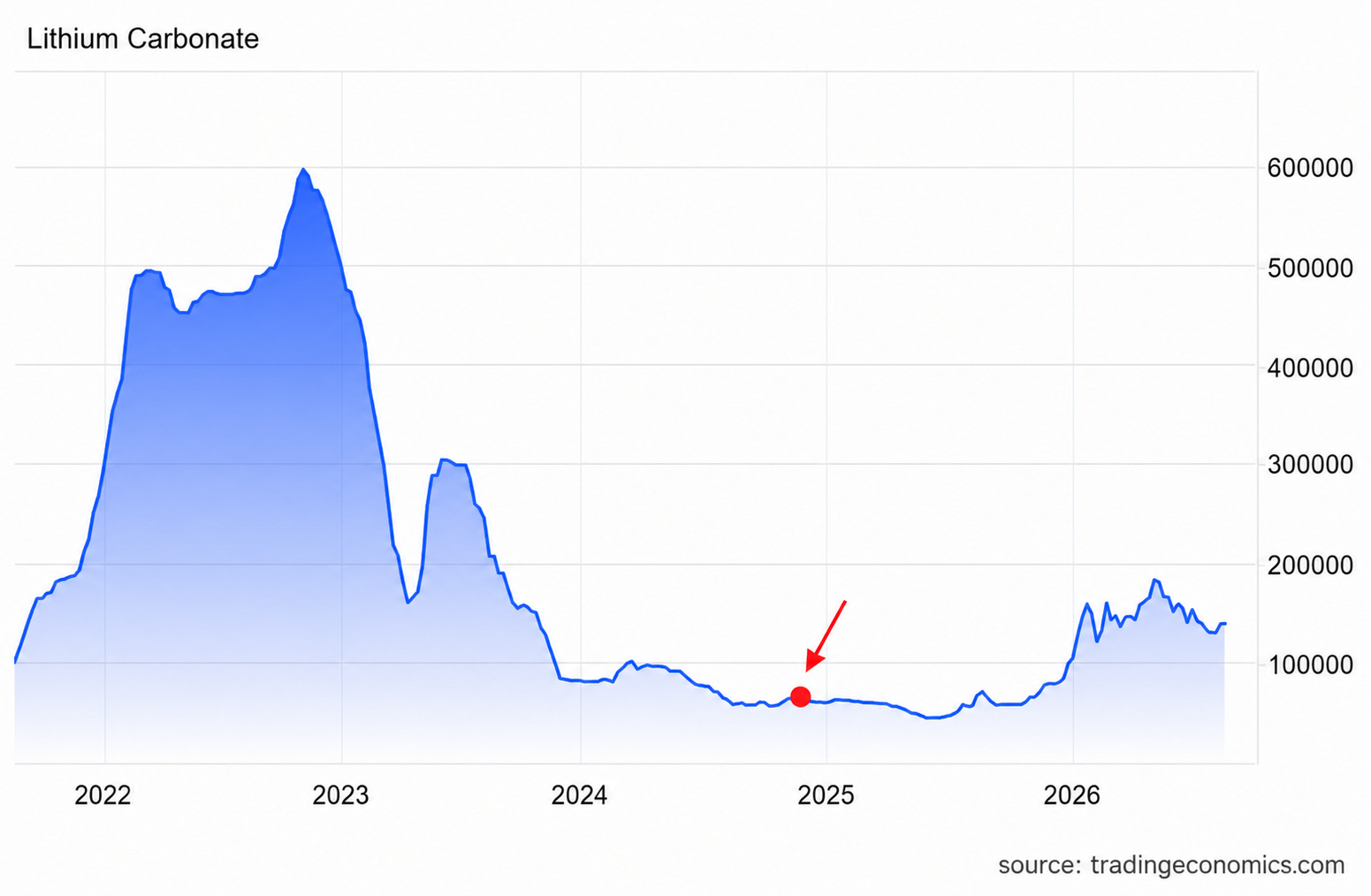
In other words, the lithium price has roughly doubled since the original bid for Arizaro was negotiated.
And the difference becomes even more striking if we look at what happened in between. Lithium carbonate subsequently fell to around CNY 60,000 per tonne in 2025 before recovering sharply.
This is important for the investment case. It does not mean Arizaro must now be worth twice as much.
Mining projects are not valued by simply multiplying their value by the change in today’s spot commodity price. Long-term lithium assumptions, development capex, financing costs, operating costs, permitting and execution risk all matter.
But it does raise an obvious question:
If a strategic buyer was willing to pay around $180 million for Arizaro when lithium was trading near the bottom of its cycle, what could another strategic buyer be willing to pay today?
The $175 million price may therefore not represent the maximum value Lithium Chile could ever realize from Arizaro.
It may instead represent a price whose economic origins date back to a substantially weaker lithium market.
That becomes particularly important when considering what happens if Canada ultimately blocks the China Union transaction.
Lithium Chile does not disappear after the transaction
Before getting to that downside scenario, there is another part of the valuation that should not be overlooked. The Arizaro sale is not a liquidation of the entire company.
Lithium Chile retains a sizeable portfolio of lithium properties in Chile.
Most importantly, the company retains Block IV at Arizaro, which is excluded from the transaction, as well as its Chilean portfolio.
The most important remaining asset is Salar de Coipasa. Coipasa was selected by the Chilean government for a Special Lithium Operation Contract, or CEOL, giving Lithium Chile an important position from which to advance the project.
Historical exploration has produced encouraging results, including lithium concentrations of up to approximately 1,410 mg/l in near-surface brines.
Lithium Chile also owns numerous other exploration properties and has a partnership with French mining group Eramet covering several Chilean assets.
Assigning an exact value to those projects today would involve a considerable amount of guesswork. But assigning them zero seems equally unreasonable.
In other words, if the $175 million transaction closes, shareholders potentially receive substantial capital back while retaining exposure to another portfolio of lithium assets.
What if the deal fails?
This is, in my view, one of the most interesting parts of the investment case.
Investors naturally focus on the $175 million upside if China Union completes the transaction. But an asymmetric investment only becomes interesting when the downside is also understandable.
Suppose Canada ultimately blocks the deal. Lithium Chile obviously does not receive the $175 million. The stock would almost certainly react negatively.
But something important has not changed: Arizaro would still exist.
Lithium Chile would once again control an advanced lithium project containing more than four million tonnes of LCE for which a strategic buyer was prepared to pay around $180 million.
And importantly, that valuation was established when lithium prices were roughly half today’s level.
That does not guarantee that another buyer would offer more. But the backdrop is clearly more favourable today than it was when the original bid was made.
This creates a somewhat unusual situation.
A failed transaction could initially be very negative for the share price while potentially giving Lithium Chile the opportunity to re-market Arizaro at a higher valuation.
The company could approach a non-Chinese strategic buyer that creates fewer political problems for Canada: a Western miner, a Japanese or Korean industrial group, a battery manufacturer, a commodity producer looking for lithium exposure, or another strategic investor interested in securing long-duration lithium supply.
There is absolutely no guarantee that a second sales process would result in a price above $175 million.
But neither is there a good reason to assume that $175 million, negotiated when lithium prices were much lower, represents a permanent ceiling on Arizaro’s value.
The failure of the current transaction and the destruction of Arizaro’s underlying value are therefore two very different things. That distinction is crucial.
The lithium market also matters
This brings us to the broader lithium cycle.
Lithium went through an extraordinary boom and bust after 2022. Prices collapsed as new supply arrived and EV growth disappointed some of the more aggressive expectations embedded in commodity prices.
That weakness is precisely the environment in which the original Arizaro bid was negotiated.
The picture today is different.
Lithium carbonate has recovered sharply, with prices around CNY 150,000 per tonne compared with roughly CNY 75,000–80,000 when the original offer was made.
Electric vehicles remain the largest structural source of lithium demand, while stationary battery storage has emerged as an increasingly important second growth engine.
The latter is particularly interesting because grid storage is growing from a much smaller base and provides lithium demand that is not directly dependent on EV adoption.
There are still plenty of reasons to remain cautious.
Higher prices encourage additional supply. Idled capacity can restart. New projects continue to be developed. Chinese production decisions can have an enormous impact on the market.
Lithium remains an extremely volatile commodity.
So I am not making the argument that lithium prices will simply continue rising.
The point is narrower: the commodity environment in which Arizaro was originally valued at around $180 million was considerably worse than the environment today.
For a company whose current entire market capitalization is only $69 million, that is an important piece of information.
Four ways this can play out
I don’t think Lithium Chile should be viewed as a simple binary bet on whether Canada approves the transaction.
There are at least four economically different outcomes.
1. The deal closes more or less as planned
This remains the cleanest outcome.
China Union receives the required approvals, the Canadian issue is resolved and Lithium Chile receives $175 million in gross cash consideration.
Against a current market capitalization of roughly $69 million, the transaction value alone is around 2.5 times the value of the entire company.
After taxes, expenses, escrow and the cash retained inside Lithium Chile, the amount returned to shareholders would obviously be lower.
But shareholders would also retain ownership of the company’s remaining lithium portfolio.
At today’s valuation, this scenario offers substantial upside.
2. The deal survives, but closing is delayed for many months
This would be frustrating rather than thesis-breaking.
A lengthy Investment Canada process could push the closing well beyond the timetable investors previously expected.
That reduces the present value of the transaction and increases uncertainty, but it does not necessarily reduce the ultimate $175 million consideration.
In this scenario, the market would essentially be charging shareholders for time and regulatory risk.
If the deal ultimately closes on the same economics, a prolonged period of uncertainty could simply create a larger discount before the value is eventually realized.
3. China Union is blocked, but Arizaro is sold to another buyer
This is perhaps the most interesting alternative outcome.
If Canada refuses to allow China Union to acquire the project, Lithium Chile would retain Arizaro and could launch a new sales process.
The important point is that the original $180 million valuation was negotiated in late 2024, when lithium prices were dramatically lower than they are today.
A new buyer would of course not automatically pay more.
But Lithium Chile would be marketing the asset into a much stronger lithium-price environment and could specifically target buyers that are less politically sensitive from a Canadian perspective.
It is therefore possible that the collapse of the current deal would not destroy the $175 million reference value.
Under favourable circumstances, a new process could even produce better economics than the existing transaction. There is a certain irony here.
Canada blocking the China Union deal could initially destroy substantial stock-market value while potentially giving Lithium Chile the opportunity to negotiate a better transaction later.
4. Arizaro remains stranded for years
This is the real bear case.
The worst outcome is not simply that China Union walks away. It is that Lithium Chile subsequently fails to find another buyer or strategic partner and is forced to continue advancing Arizaro itself.
The project requires more than $1 billion of initial development capital according to the PFS. Lithium Chile cannot fund that alone.
The company would then face the familiar problems of a junior mining developer: repeated equity raises, dilution, financing risk, permitting risk, commodity-price exposure and a potentially very long wait before shareholders see any cash return.
Under those circumstances, today’s apparent discount to the $175 million transaction value becomes much less meaningful.
That is the outcome that would genuinely weaken the investment thesis.
The asymmetry is more subtle than it first appears
This is therefore not simply:
Deal succeeds = good.
Deal fails = bad.
There are several layers.
A relatively quick closing would obviously unlock the value fastest.
A long regulatory delay destroys some value through time but does not necessarily alter the ultimate economics.
A failed China Union transaction could initially hurt the stock substantially but might allow Lithium Chile to re-market Arizaro in a lithium market that is considerably stronger than the one in which the original $180 million price was negotiated.
Only the fourth outcome — where neither China Union nor another buyer can monetize Arizaro on acceptable terms for a prolonged period — really undermines the central valuation argument.
That is why I don’t think the current $69 million market capitalization can simply be interpreted as the market applying a probability to $175 million of future cash.
Investors are also implicitly assigning a value to what happens if that cash never arrives.
And with lithium prices roughly twice where they stood when the original bid was made, I think that residual value may be considerably higher than the current share price suggests.
So why is the stock this cheap?
Because markets hate uncertainty.
Lithium Chile shareholders have now been waiting for this transaction for a long time.
First there was an LOI.
Then negotiations for a definitive agreement.
Then shareholder approval.
Then Chinese capital controls.
Then an extension of the closing deadline.
And now Canada has unexpectedly raised national-security concerns.
A dollar that may arrive several months from now is obviously worth less than a dollar already sitting in the company’s bank account. And a dollar that might never arrive deserves a much larger discount.
So some discount is entirely justified.
The question is how large that discount should be.
At CAD 0.43, the market values all of Lithium Chile at approximately $69 million. That is less than 40% of the agreed $175 million Arizaro sale price. And that valuation includes all of Lithium Chile’s remaining assets as well.
Furthermore, the $175 million reference price itself originated in a period when lithium prices were roughly half today’s level.
For me, that is where the situation becomes particularly interesting.
Conclusion
Lithium Chile is not a risk-free arbitrage where you can buy a dollar for forty cents.
The Canadian intervention makes that very clear.
Canada has previously forced a Chinese investor to divest its stake in Lithium Chile, and investors who simply ignore that precedent are ignoring one of the most important risks in the investment case.
But I think the opposite conclusion goes too far as well.
A Canadian national-security notice does not suddenly make Arizaro worthless.
There is a signed $175 million definitive agreement. China Union has paid a $5 million deposit. Approximately 96% of shareholder votes supported the transaction. The relevant approvals in Argentina have been obtained. The buyer has already committed resources to preparing the project.
And even if this particular transaction ultimately fails, Lithium Chile retains a major lithium project for which an external buyer was demonstrably willing to pay around $180 million when lithium prices were substantially below today’s level.
Against all of that stands a current market capitalization of only around $69 million.
The investment case is therefore riskier today than it was when I first wrote about Lithium Chile.
The probability of a quick and uncomplicated closing has clearly fallen.
But the asymmetry has not disappeared.
If the transaction closes, today’s valuation looks extremely low. If closing is merely delayed, shareholders are mainly paying a price in time.
If China Union is blocked but Arizaro is eventually sold to someone else, today’s valuation could still prove far too low — and the stronger lithium market creates at least the possibility of a better transaction.
The scenario that really matters on the downside is the one in which Lithium Chile cannot monetize Arizaro for years and is forced to finance its development itself.
At CAD 0.43, the market seems primarily focused on everything that can still go wrong.
The more interesting question is what Lithium Chile is worth if just one of the available paths to monetizing Arizaro eventually succeeds.
I put my money where my mouth is. I’m convinced enough that I doubled my position yesterday at CAD 0.43.
Thanks for the deep dive. Has there been any notable developments on your thesis since you posted the write up?